Think of coordination, not duplication
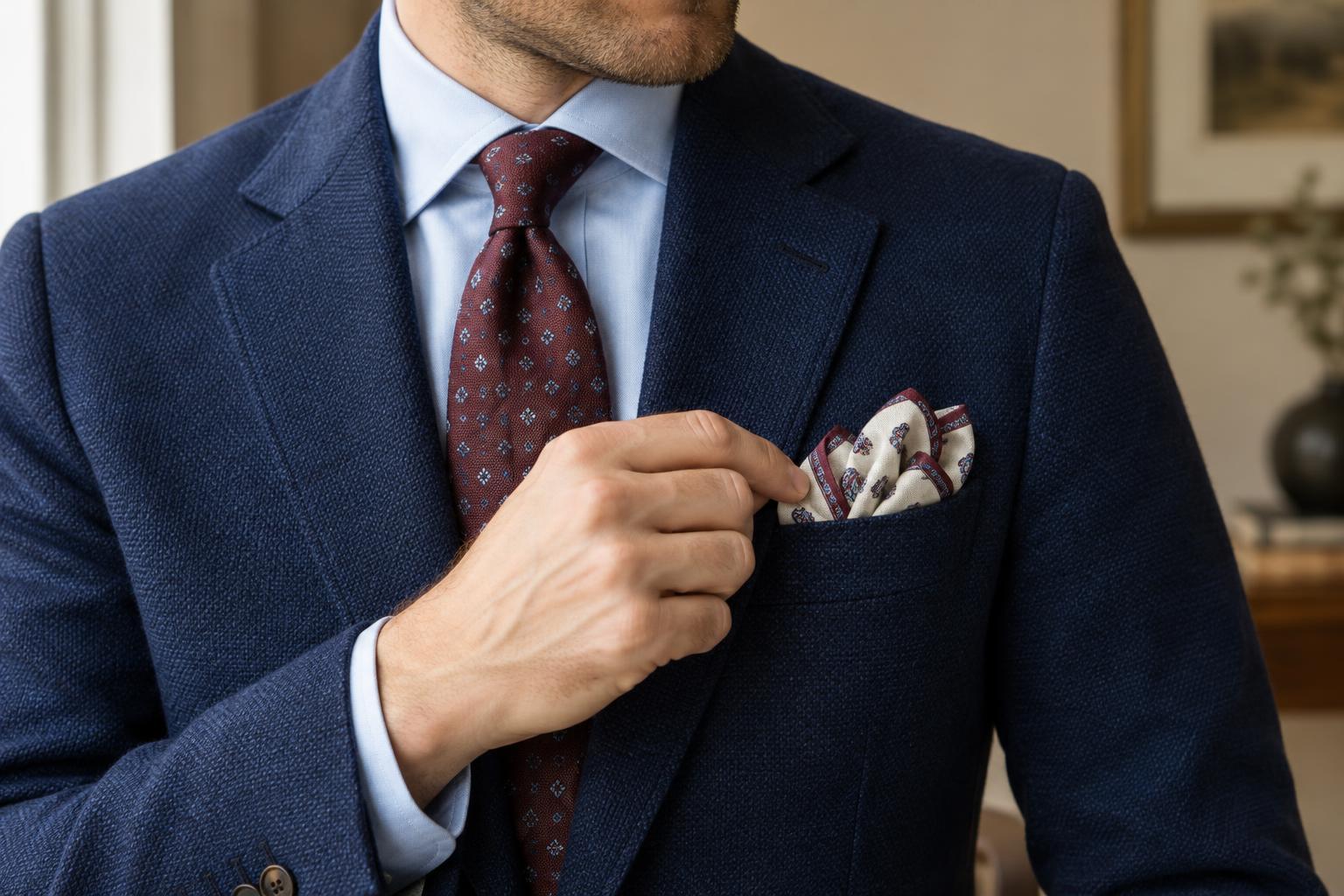
A pocket square and tie share a small space, so it is natural to want them to match. But when both use the same fabric and pattern, the result can look more like a packaged set than a personal choice. A better aim is coordination: the two accessories should make sense together while doing different jobs. Your tie draws the eye down the center of your outfit; the pocket square adds a smaller accent near your face.
Start with your jacket and shirt, then choose your tie. Once those pieces work together, select a square that relates to at least one color or quality already in the outfit. It does not have to repeat the tie’s main color. A navy tie, for example, can sit beside a square with a small navy detail, or beside an off-white square that picks up a light shirt. The connection should be easy to notice without looking identical.
Use color to create a quiet connection
The simplest approach is to pull a secondary color from your tie. If a burgundy tie has a subtle blue motif, a blue pocket square can echo that detail without copying the tie. You can also work with different shades of one color: a pale blue square can complement a darker blue tie, especially when a white or light-blue shirt gives the combination some breathing room.
When you are unsure, look at the whole outfit rather than judging the accessories side by side. A square can connect to the shirt, jacket, or even a muted color in a patterned knit instead of the tie. Keep the overall palette manageable. If the jacket, shirt and tie already carry several strong colors, a white, cream or softly colored square may be enough. The goal is for the square to support the outfit, not introduce a new theme.
Balance patterns and texture
Pattern is another way to keep the accessories distinct. With a bold striped or patterned tie, try a plain square or one with a restrained border. With a solid tie, a small print can add interest. Two patterned pieces can work together, but give them different scales. A tie with broad stripes is less likely to compete with a square covered in tiny dots than with one that has stripes of a similar width.
Texture matters as much as print. A smooth silk tie and a matte linen or cotton square offer contrast without needing much color. A textured wool tie can pair well with a soft silk square for the same reason. You need not follow a strict seasonal formula, but consider how the materials feel beside your jacket. A crisp linen square often suits a lighter, more relaxed look; a softly folded silk square can bring a little movement to a more formal one.
Choose a fold that suits the occasion
The fold changes how noticeable your pocket square becomes. A straight fold shows a narrow, clean line and works well when you want the jacket and tie to lead. It is a useful starting point for work outfits, weddings and other occasions where a tidy appearance feels right. A relaxed puff reveals more fabric and suits an outfit that has room for a softer accent.
Do not worry about making a puff perfectly symmetrical. Place the square in the pocket, then adjust the visible fabric until it looks intentional rather than bulky. Only a modest amount needs to show. If your square keeps sinking, try a slightly fuller fold or a fabric with more structure. Whatever the fold, let the square sit comfortably in the pocket rather than forcing it into a rigid shape.
Build combinations from what you own
You do not need a drawer full of squares to avoid exact matching. A plain white square is versatile with many ties and jackets. From there, one muted color and one modest pattern can provide useful variety. Before buying another, lay out the jackets and ties you wear most often and look for a square that works with several combinations, not just one.
Try the finished outfit on and step back from the mirror. If the tie and square seem to compete, make one quieter: switch to a plainer square, show less of it, or choose a softer shade. If the square disappears, a subtle border or contrasting texture may be all you need. These small adjustments are more useful than a rule that every accessory must match. The best pairing looks connected when you see the full outfit, yet each piece still has its own purpose.