Aim for tidy, not transformed
The easiest way to over-trim facial hair is to start without deciding what you want to change. For everyday grooming, the goal is usually modest: tame eyebrow hairs that stick out and shorten nose or ear hairs that are visible. You do not need to remove every hair. Keeping a little natural variation tends to look more relaxed than trying to make both sides perfectly identical.
Work in bright, even light with a mirror at a comfortable distance. A magnifying mirror can help you find a stray hair, but step back to a normal viewing distance before removing it. That is how other people will usually see you. Begin with clean, dry tools, make a small adjustment, and check the result before doing more. If you are unsure whether a hair needs attention, leave it for the next session.
Tidy eyebrows one hair at a time
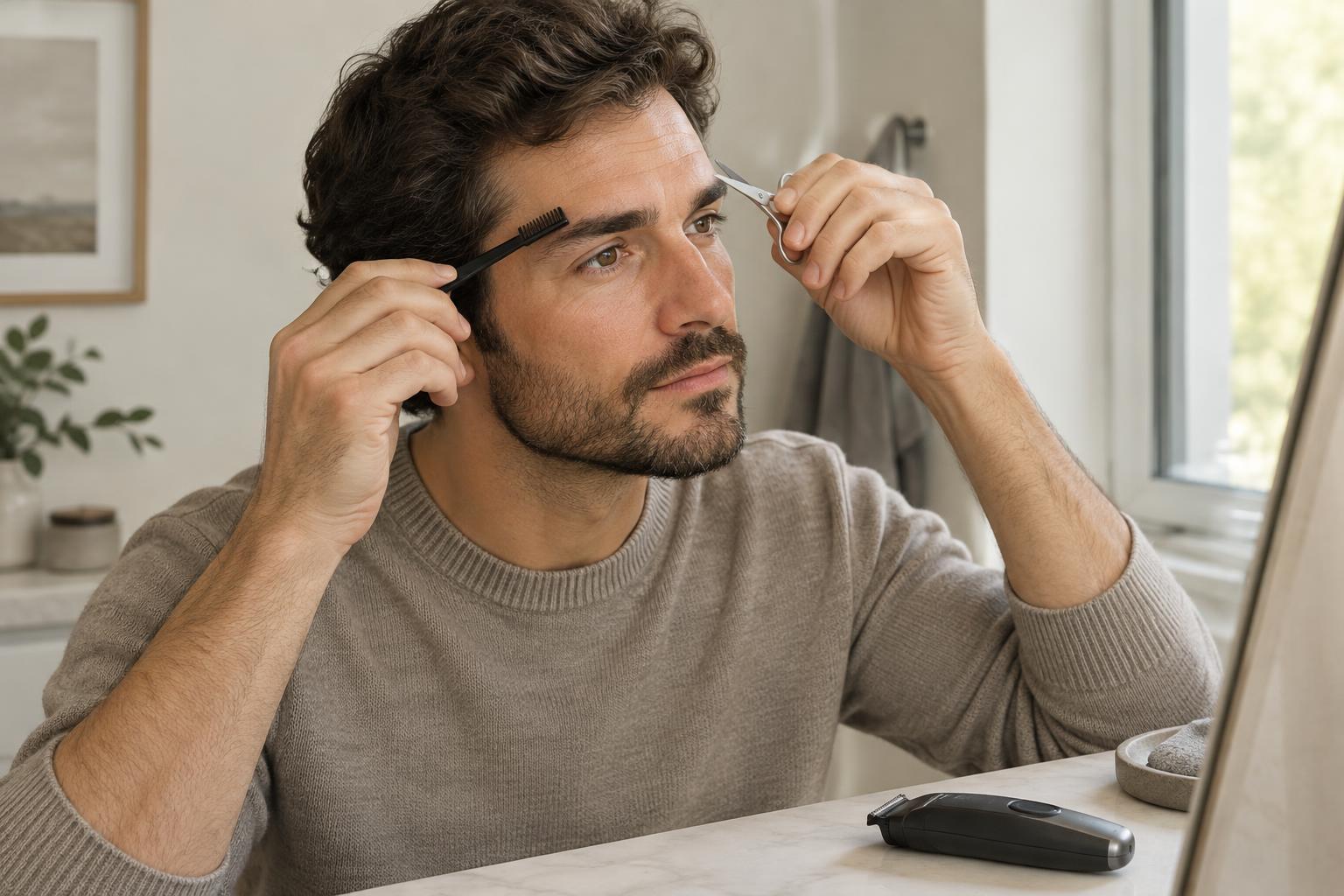
First, brush each eyebrow upward with a clean spoolie or small brow comb. Look for long hairs that extend noticeably beyond the brow’s upper outline. Hold small grooming scissors parallel to that outline and snip only the protruding tips. Brush the hairs back into place and reassess. Cutting a straight line across the whole brow can leave a blunt edge or reveal gaps when the hairs settle.
If you want to remove stray hairs, tweezers offer more control than a razor. Consider plucking obvious hairs between the brows or well outside their natural shape, rather than carving a new arch. Pull one hair at a time in its direction of growth, then pause and look at your whole face. Brows are not exact mirror images; chasing symmetry can make both thinner than intended. If your skin becomes irritated, stop and let it settle before doing anything else.
Trim visible nose hair, not everything inside
Nose hair is easy to notice when a few strands reach beyond the nostril, but the hair farther inside does not need to be removed for a neat appearance. Use a rounded-tip nose-hair trimmer or a small pair of rounded-tip grooming scissors. In good light, gently lift the tip of your nose and trim only the hairs visible at the opening. Keep the tool near the edge rather than pushing it deep inside.
Avoid pulling nose hairs out with tweezers or wax for a routine tidy-up; trimming is a less forceful way to deal with visible strands. Follow the trimmer’s cleaning instructions and let it dry before storing it. You may find that one short pass is enough. Check again from an ordinary angle before making a second pass, since a close-up mirror can make a few harmless hairs seem more prominent than they are.
Keep ear grooming on the outside
For ears, focus on hair you can see on the outer ear or at the entrance to the ear canal. A compact trimmer with a suitable guard can shorten it without requiring a very close cut. If you use scissors, choose rounded tips and work only where you can clearly see the hair. Do not insert scissors, tweezers, or a trimmer deep into the ear canal.
Ears are awkward to view, so use two mirrors or ask someone you trust to point out any visible strands. Trim slowly rather than sweeping a tool around by feel. If hair lies flat against the outer ear and is barely noticeable at a normal distance, it may not need attention. The aim is to remove distractions, not to make the skin look completely hairless.
Build a routine that leaves room to stop
Check these areas during your usual grooming routine rather than making a major project of them. You might notice a stray eyebrow hair while washing your face or a visible nose hair before getting dressed. Deal with that specific hair and move on. Regular, small touch-ups are easier to control than removing a lot at once, especially with eyebrows, where an overenthusiastic trim can change your expression.
Keep tools clean, dry, and reserved for their intended use. Replace a dull trimmer head or scissors that pull instead of cutting. If a spot is sore, broken, or unusually sensitive, leave it alone rather than trying to make it look perfect. The best final check is simple: put the tools down, step back from the mirror, and see whether your face looks like yours—just a little tidier.