Start with the garment as a whole
Quality is not one visible detail. A garment needs suitable fabric, a comfortable fit, and construction that can handle its intended use. A lightweight summer shirt and a heavy overshirt will not be built in exactly the same way. The useful question is whether the construction suits the garment and looks consistent throughout it.
Before examining individual stitches, hold the piece up and look at its shape. Do the sleeves appear even? Does the collar sit symmetrically? On a patterned item, check whether prominent lines meet neatly at obvious points such as a front placket or pocket. Perfect pattern matching is not essential everywhere, but conspicuous misalignment can make a garment look careless. Then turn it inside out: the interior often reveals details that a pressed exterior conceals.
Read the stitching, not just the stitch count
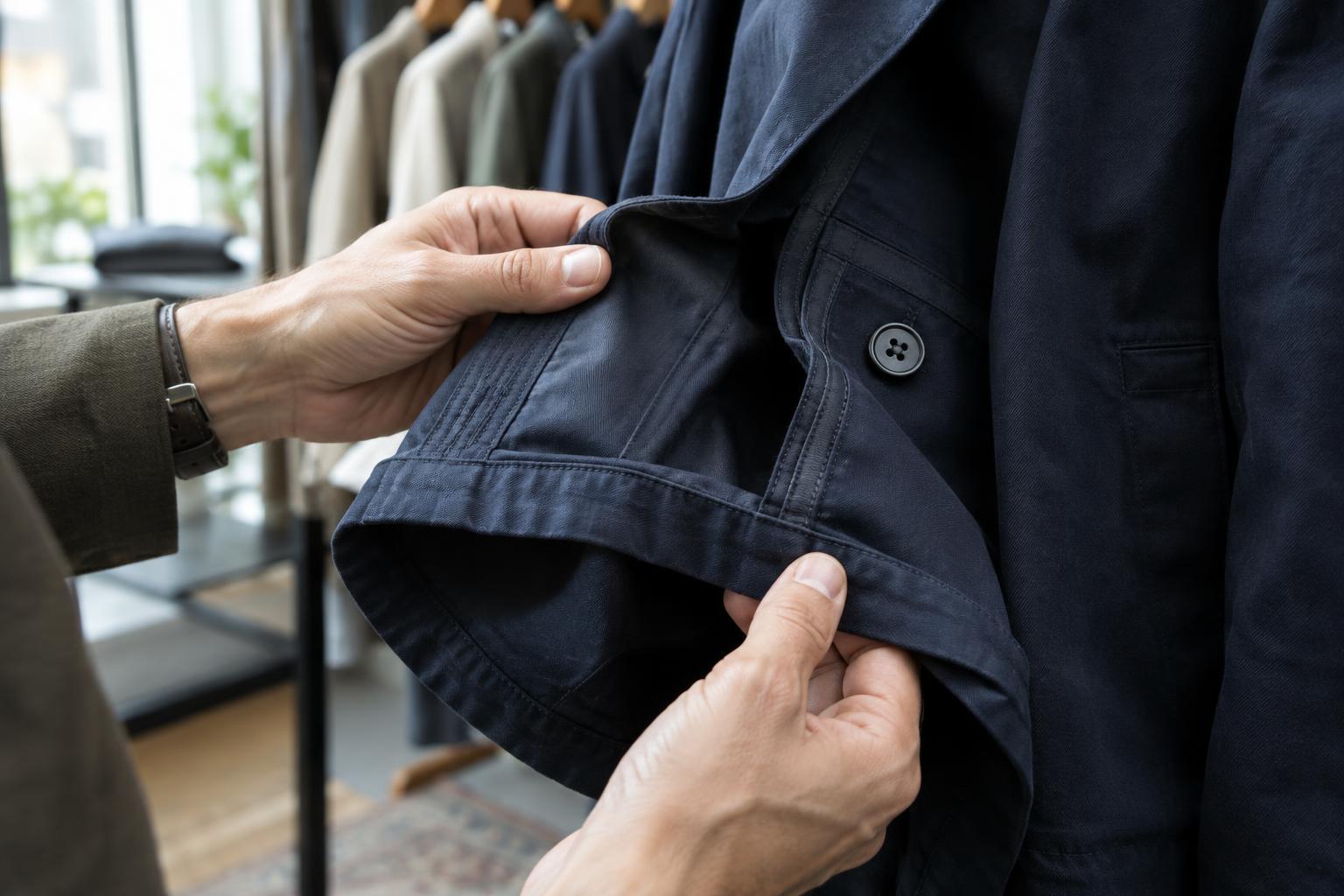
Follow a few lines of stitching along the side, shoulder, cuff, and hem. Stitches should generally be even, with no long skipped sections, loose loops, or thread ends coming free. A short thread tail that has not been trimmed is usually a minor cosmetic issue; a seam that opens when gently handled is not. Look closely where two seams meet, as bunching or crooked stitching can be easier to spot there.
More stitches per inch do not automatically mean a better garment. Very dense stitching can weaken some fabrics by putting many needle holes close together, while a longer stitch may be appropriate for a different material or design. Consistency and suitability matter more than an impressive-looking number. If you gently stretch a seam on a knit garment, the stitching should give with the fabric rather than immediately popping or leaving gaps.
Check seams where clothing takes strain
Seams join panels, but they also absorb movement. Pay particular attention to the crotch and seat of trousers, the underarms of shirts, and pocket openings on garments you expect to wear often. Gently pull the fabric on either side of a seam without forcing it. You should not see the panels separate dramatically or the stitching strain under light pressure.
Inside the garment, look at how raw edges are controlled. They may be enclosed, bound, folded, or finished with overlocking. These are different methods, not a simple ranking from best to worst. What matters is that the finish is appropriate for the fabric and is not already fraying or unraveling. Check that the seam allowance has enough fabric to remain secure and does not look accidentally trimmed into the stitching. On a lined item, the lining should lie smoothly rather than pulling against the outer fabric.
Inspect hems, buttons, and other finishing details
A hem should hang evenly and lie reasonably flat when the garment is worn. Rippling, twisting, or a line of stitching that wanders noticeably may become more apparent after washing. Examine trouser cuffs, shirt hems, and sleeve ends from both sides. The finish should feel secure without being so stiff that it distorts the garment's shape.
Fasten and unfasten the buttons. They should feel secure, and their buttonholes should have tidy stitching without threads blocking the opening. Test zippers through their full range; they should move smoothly without catching the surrounding fabric. Check pocket corners and other stress points for firm stitching, though the exact reinforcement will vary by design. Spare buttons are convenient, but their presence alone says little about the garment's overall quality.
Make a practical decision in the fitting room
Construction deserves a final check while the garment is on your body. Raise your arms in a shirt, sit down in trousers, and walk a few steps. Notice whether seams pull sharply, a lining restricts movement, or a hem twists out of place. Some tension may mean the fit is wrong rather than the sewing is poor, but the result is the same: the piece is unlikely to be comfortable in regular use.
If you find one loose thread, ask whether it is isolated or part of a wider pattern. A crooked seam, weak pocket opening, and uneven hem on the same item give you a clearer reason to pass. Compare garments by how they suit your needs, not by price or brand alone. A well-fitting piece with secure seams and neat finishing is often a more useful wardrobe addition than one that merely looks impressive on the rack.