Start with your wrist, not a case-size rule
Watch diameter is useful for narrowing your options, but it does not tell you how a watch will wear. Two cases with the same diameter can look different because of their bezels, dial openings, shapes and lugs. A broad dial may appear larger than a watch with a wider bezel, while a cushion-shaped case may occupy more of the wrist than its stated diameter suggests.
If you can, measure the circumference of your wrist with a soft tape, or wrap a strip of paper around it and measure the strip. This helps when ordering a strap or checking a maker’s sizing guide. It is a starting point rather than a rule about which case diameter you should buy. Wrist width and shape matter too: a flatter wrist may support a longer case differently from a rounder wrist with the same circumference.
The most useful test is to try a watch on and look at it from a short distance, as you would when checking an outfit. It should feel proportionate to your hand and forearm, not just look appealing in a close-up photo. If you are buying online, compare all the available dimensions and check the return terms so you can assess the fit at home.
Check lug-to-lug length, thickness and weight
Lug-to-lug length is the distance from the tip of the upper lugs to the tip of the lower lugs. It helps show how much space the case will take up along your wrist. As a practical check, the lugs should generally stay within the edges of the wrist rather than project beyond them. Curved lugs may hug the wrist, while straight, extended lugs can make an otherwise modest case wear larger.
Case thickness changes comfort and appearance. A thick watch can feel top-heavy or catch on a fitted shirt cuff, even if its diameter looks right. A slim case may sit more easily under a sleeve and feel less noticeable through the day. If the watch is intended for work clothes, try it with the cuff you actually wear rather than assuming it will slip underneath.
Weight also deserves attention. Some people enjoy the feel of a substantial watch; others find it tiring. Notice whether the case stays centered when you move your arm. A heavy case on a loose strap may slide toward your hand, while tightening the strap enough to stop it may become uncomfortable. That is a fit problem worth solving before purchase.
Choose a strap that matches how you wear the watch
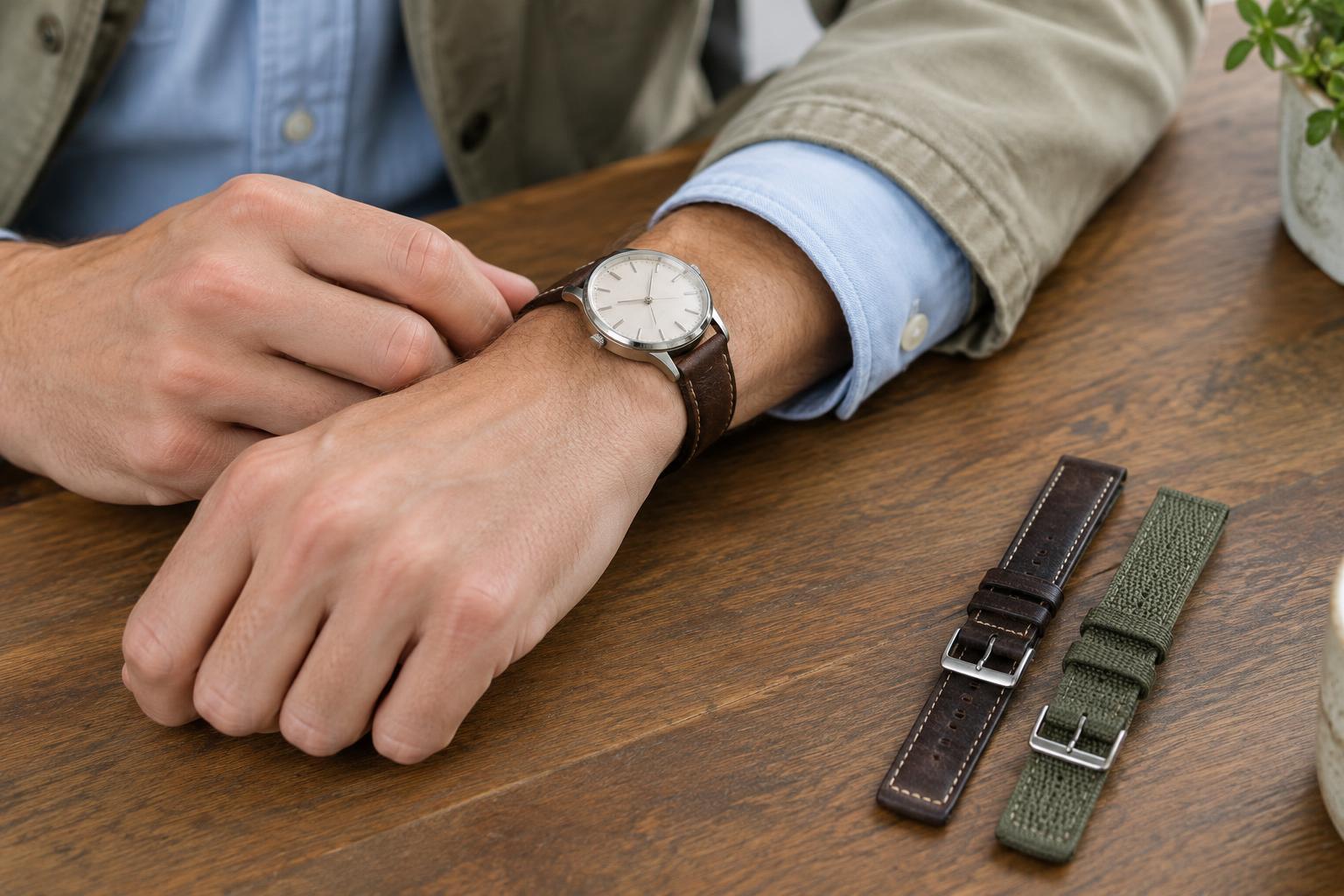
Leather offers a tidy look that works with many smart-casual and tailored outfits. Smooth, lightly padded leather tends to look more formal; textured or softer leather can make the same watch feel relaxed. Leather can be uncomfortable when repeatedly soaked, so give it time to dry naturally and consider another material for frequent wet or sweaty conditions.
Metal bracelets are versatile and can be adjusted by removing links, changing a clasp setting or both, depending on the design. Their fit can change as your wrist expands or contracts during the day, so allow a little movement without letting the watch spin freely. Fabric straps are often light and casual, and many are easy to swap. Rubber or silicone can suit active use, provided the material and buckle feel comfortable against your skin.
The strap should also suit the case. A delicate dress watch can look overwhelmed by a thick, bulky strap; a larger sports watch may need something more substantial to feel balanced. Color need not match every accessory exactly. A restrained strap color that relates to the rest of your outfit is usually easier to wear across different occasions.
Get the width, length and adjustment right
Strap width is measured where the strap meets the case, between the lugs. Check that measurement before buying a replacement: a strap that is too wide may not fit, and one that is too narrow can leave visible gaps or sit insecurely. Some straps taper toward the buckle, which can make a broad case look a little lighter on the wrist.
Length matters as much as width. On a buckle strap, you want enough holes to adjust for comfort and enough tail to sit neatly in the keepers, without an excessive length wrapping around your wrist. If you are between standard lengths, check the lengths of both strap pieces rather than relying only on labels such as short or regular. With a bracelet, ask whether links can be removed and whether the clasp offers smaller adjustments.
Aim for a fit that holds the watch roughly in place without leaving a deep mark or pinching when you flex your hand. Wear it for several minutes, move your wrist and check it again. A watch may feel fine while your arm is still but shift when you walk or type.
Make the final choice in the context of your wardrobe
Think about where the watch will spend most of its time. For an everyday choice, comfort and easy pairing may matter more than a dramatic wrist presence. If you often wear narrow cuffs, favor a case and strap that pass underneath them without a struggle. If your wardrobe is mostly casual, a practical bracelet or durable strap may get more use than a delicate leather one.
You do not need a collection to handle different outfits. If the watch accepts replaceable straps, one well-fitting case can take on different looks with a simple strap change. Confirm the lug width and attachment method first, and use the appropriate tool or seek help if you are unsure how to remove a strap without scratching the case.
The right size is the one you can wear comfortably and confidently. Treat measurements as a shortlist, then judge the watch on your wrist: check the case edges, how the strap sits, whether the watch stays centered and how it works with your usual clothes.