Start with the outfits you already wear
A sweater earns its place in a wardrobe when it makes familiar outfits easier to wear. Before choosing a neckline, look at the shirts, trousers, jackets, and shoes you reach for most often. If your everyday uniform is jeans and a T-shirt, a crewneck may be the simplest addition. If you regularly wear collared shirts, a V-neck or cardigan may give you more ways to layer. The goal is not to own every style; it is to fill a gap.
Think about where you will wear the sweater, too. A neat, fine-gauge knit can sit comfortably under a blazer or coat, while a thicker knit often works better as the main layer over a shirt. Color matters as much as shape: navy, charcoal, gray, and muted brown tend to combine easily with common wardrobe basics. Choose a color you will wear with at least a few existing outfits rather than one that only looks appealing on its own.
Crewnecks: the straightforward all-rounder
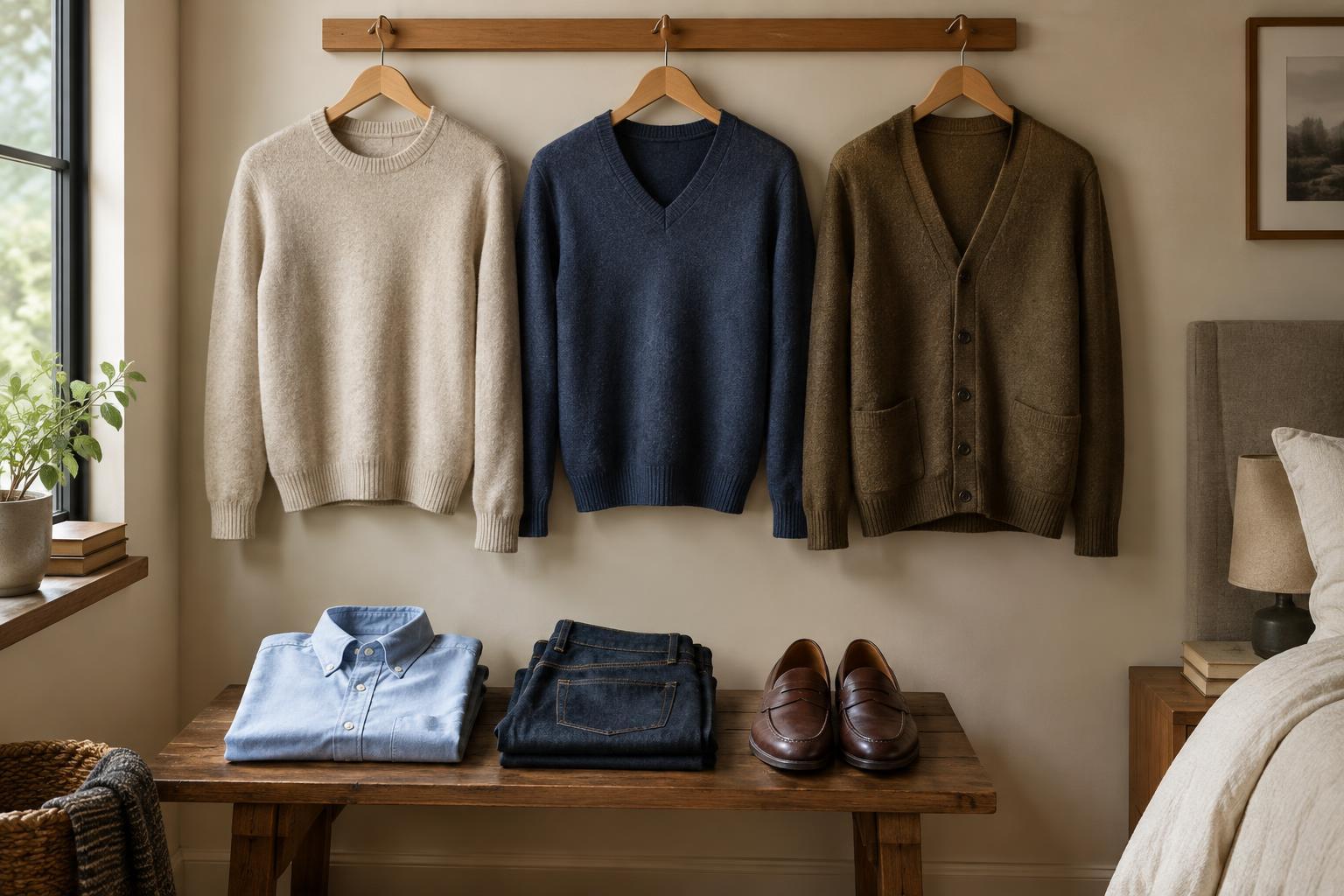
A crewneck has a rounded neckline that frames the face and keeps the outfit visually simple. It works over a T-shirt for casual days and over a button-down shirt when you want a slightly sharper look. Under a jacket, a smooth, relatively thin crewneck adds warmth without requiring much adjustment. Its versatility makes it a sensible first sweater for someone building a small wardrobe.
Check how the neck sits before buying. It should lie comfortably without feeling tight or stretching wide across the collarbones. When you layer a collared shirt underneath, decide whether you like the collar tucked in or visible; a bulky shirt collar can make an otherwise tidy crewneck look crowded. A midweight crewneck is particularly useful if you want to wear it alone indoors and under outerwear when it gets colder.
V-necks and cardigans: two different kinds of flexibility
A V-neck leaves room to show a shirt collar and a small amount of the shirt beneath it. That makes it a natural partner for an Oxford or dress shirt, especially in outfits where you might otherwise wear a jacket. The opening should feel proportionate: a very deep V can draw more attention to the neckline than you intend, while a shallow one looks closer to a crewneck. Try it with the shirts you expect to wear underneath.
A cardigan offers a different advantage: you can button it, leave it open, or take it off easily as temperatures change. A fine-knit cardigan can act as a soft middle layer under a coat; a heavier one can replace a casual jacket in mild weather. For a clean appearance, make sure the front edges hang evenly and the buttons do not pull across your chest or stomach. If you usually wear open layers, a cardigan may be more useful than another pullover.
Choose fit and fabric for the job
Whatever the neckline, the shoulder seam should sit close to your natural shoulder, and the body should allow a shirt underneath without hanging loosely when worn alone. Sleeves should reach around the wrist, with cuffs that stay in place rather than sliding over your hands. Pay attention to the hem: a sweater that rides up each time you move or bunches heavily at the waist will be difficult to wear neatly. Try sitting and reaching forward as well as standing still.
Fabric and knit structure affect both comfort and appearance. Cotton can feel familiar and is often useful in milder weather, though it may be relatively heavy for its warmth. Wool is an option when warmth and temperature flexibility matter, but its feel varies by yarn and finish; if you are sensitive to it, try the sweater on over the layers you normally wear. Blends can also be practical. Compare how each sweater feels, drapes, and holds its shape instead of choosing by fiber name alone.
Build a small rotation and keep it wearable
If you are starting with one sweater, choose the style that fits your most common outfit. A crewneck is a reliable choice for casual and mixed wardrobes; a V-neck makes sense if collared shirts are a daily staple; a cardigan suits someone who values an adjustable layer. For a second sweater, change either the function or the texture. A smooth knit for layering and a more substantial knit for wearing on its own offer more range than two nearly identical purchases.
Care helps any choice stay useful. Follow the garment’s label, avoid hanging heavier knits for long periods if the shoulders start to stretch, and fold sweaters when storing them. Airing a sweater between wears may reduce unnecessary washing; when it does need cleaning, use a method suitable for its fabric and reshape it as directed. Address small pills gently rather than pulling at them. A sweater that fits well, works with your clothes, and is easy to maintain is more valuable than one reserved for a perfect outfit that never comes.